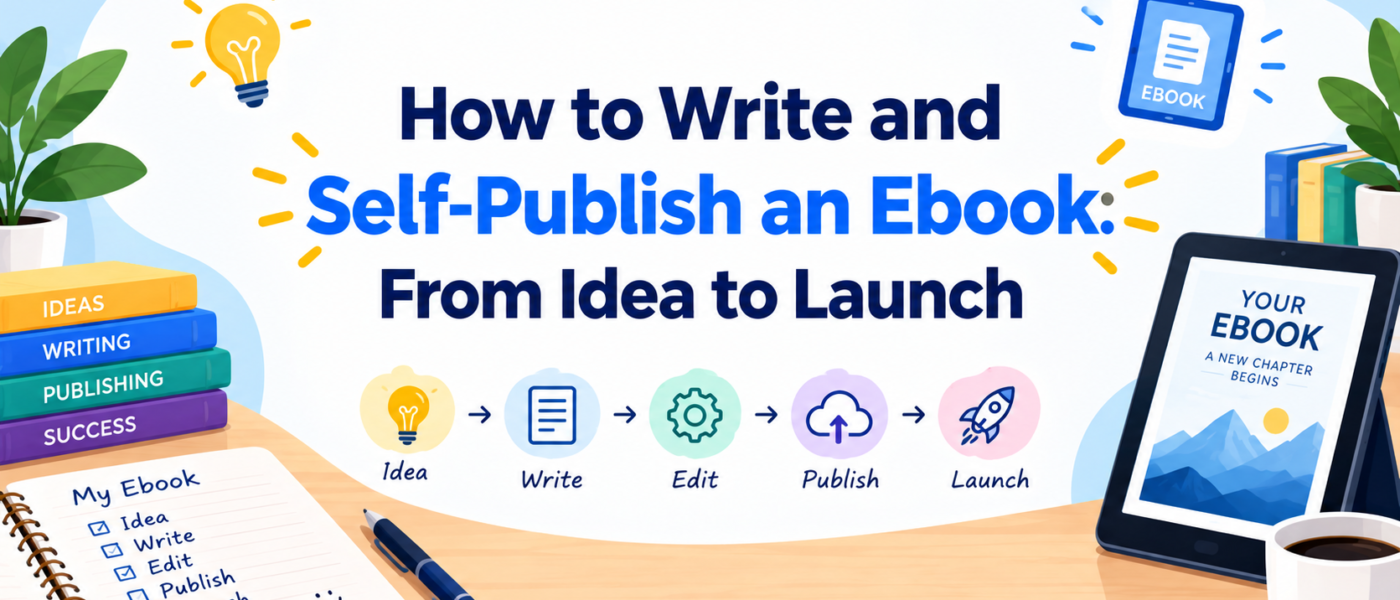
Ebooks are one of the most accessible digital products you can create. They require no inventory, can be delivered instantly, and allow you to share expertise on almost any subject. Whether you want to publish a how-to guide, a workbook, a collection of stories, or a reference manual, the process follows a similar path: choose a topic, plan the structure, write and edit, design the layout and cover, convert the file to the right format, and publish. This guide walks through each stage in practical detail so you can turn an idea into a finished ebook.
Why Ebooks Remain a Strong Digital Product
- Low startup cost. A computer and writing software are enough to begin.
- Multiple income channels. You can sell through online bookstores, your own website, or as a bonus to attract email subscribers.
- Authority building. A well-written book positions you as a knowledgeable voice in your field.
- Reusable content. Chapters can become blog posts, courses, checklists, or newsletters.
- Global reach. Readers anywhere with a device can access your work.
Step 1: Choose a Topic With Reader Demand
The best ebook topics sit at the intersection of what you know, what readers want, and what you can explain clearly. Begin by listing subjects where you have practical experience. Then check whether people are looking for books on those subjects.
Ways to validate your idea
- Browse online bookstore categories and look at bestseller lists in your niche.
- Read reviews of similar books to see what readers liked and what they found missing.
- Search for common questions in forums and social groups related to your topic.
- Check whether related blog posts and videos attract steady attention.
Specific topics usually perform better than broad ones. \”A Beginner\’s Guide to Designing Printable Planners\” has a clearer audience than \”Design Tips.\”
Step 2: Define Your Reader and Promise
Write a one-sentence promise: \”This book helps [type of reader] achieve [specific outcome] by [method].\” This sentence guides every decision, from chapter selection to cover design. If a section does not support the promise, remove it or save it for another book.
Step 3: Plan the Structure
A clear outline prevents rambling and makes writing faster. Most non-fiction ebooks follow a logical sequence:
- Introduction: who the book is for, what readers will learn, and how to use it.
- Foundations: essential concepts and vocabulary.
- Step-by-step chapters: the main process, broken into manageable parts.
- Examples and case studies: practical demonstrations of the ideas.
- Common mistakes and troubleshooting: help for typical problems.
- Conclusion and next steps: a summary and suggested actions.
- Resources: checklists, templates, glossary, or recommended tools.
Aim for chapters of similar length. For a short practical ebook, eight to twelve chapters of a thousand to two thousand words each can produce a satisfying read.
Step 4: Write the First Draft
The first draft is about getting ideas onto the page, not perfection. Set a realistic writing schedule, such as 500 to 1,000 words per day, and protect that time. Write in a conversational, clear style, as if explaining to a friend.
- Use short paragraphs and plain language.
- Start chapters with a brief overview of what readers will learn.
- Include concrete examples rather than abstract advice.
- Use subheadings so readers can scan.
- End each chapter with a short summary or action step.
Do not edit while drafting. Editing and writing use different mental modes, and mixing them slows progress.
Step 5: Edit in Layers
Structural edit
Read the whole manuscript and ask whether the order makes sense, whether any sections are repetitive, and whether anything essential is missing. Move or remove sections as needed.
Line edit
Improve clarity and flow. Replace vague words with specific ones, shorten long sentences, and remove filler phrases.
Proofreading
Check spelling, grammar, punctuation, and formatting consistency. Read the text aloud or use a text-to-speech tool to catch awkward phrasing. If your budget allows, a professional editor or proofreader can significantly raise quality. Alternatively, ask a few trusted readers for feedback.
Step 6: Respect Copyright and Accuracy
Only include text, images, and quotations that you have the right to use. Brief quotations with proper credit are generally acceptable in many contexts, but long excerpts require permission. Use licensed or original images and keep records of licenses. Verify facts, figures, and tool names so that your book remains reliable. If your topic involves areas where readers might rely on your words for important personal decisions, clearly state the limits of your guidance and encourage them to consult qualified professionals.
Step 7: Format Your Ebook
Formatting determines how comfortable the book is to read on different devices.
Common formats
- EPUB: the standard reflowable format that adapts to different screen sizes and works on most e-readers and apps.
- PDF: a fixed layout suited to workbooks, guides with detailed design, and printable materials.
- Kindle-compatible formats: online bookstores typically accept several standard files and convert them for their reading apps.
Formatting best practices
- Use built-in heading styles so a clickable table of contents can be generated.
- Keep fonts simple and avoid manual spacing tricks such as multiple blank lines.
- Insert page breaks before new chapters.
- Compress and properly size images to keep the file small.
- Test the file on a phone, a tablet, and a computer reading app.
Step 8: Design a Cover That Sells
Readers do judge books by their covers, particularly in small thumbnail form. A good cover is legible at small sizes, communicates the genre or topic, and matches reader expectations in your category.
- Use a bold, readable title and keep the subtitle short.
- Limit the design to one or two main fonts and a consistent color palette.
- Look at bestselling covers in your category for patterns, without copying them.
- Check size and resolution requirements for each sales platform.
- Consider hiring a cover designer if design is not your strength.
Step 9: Write a Compelling Description
Your description is a sales page in miniature. Open with the main problem your book solves, explain what readers will learn, and briefly describe who the book is for. Use short paragraphs and bullet points. Avoid exaggerated promises and keep your claims honest.
Choose categories and keywords carefully. Think about the phrases a reader would type to find a book like yours, and include them naturally in the title, subtitle, and description.
Step 10: Choose Where to Publish
Online bookstores and aggregators
Major bookstores allow independent authors to upload their books and reach large audiences. Some offer exclusivity programs with extra promotional tools, while others allow wide distribution across many stores. Read each program\’s terms carefully, including royalty rates, delivery fees, and exclusivity requirements.
Your own website
Selling directly lets you keep more of each sale and build a customer email list. You can use a store platform that handles payment and file delivery. The tradeoff is that you must generate your own traffic.
A combination
Many authors publish on bookstores for discovery and offer special editions, bundles, or workbooks on their own sites.
Step 11: Pricing Considerations
Price according to the length, depth, and value of your content. Short guides often sell at lower price points, while comprehensive manuals can justify higher ones. Test different prices over time, and consider launch discounts to encourage early reviews. Avoid pricing so low that readers doubt the quality.
Step 12: Launch and Promote
- Prepare early readers. Offer advance copies to a small group in exchange for honest reviews.
- Announce to your email list. Subscribers are the most likely to buy and share.
- Publish related blog content. Articles that answer questions from the book can attract new readers.
- Share sample chapters. A free preview helps readers decide.
- Collaborate. Guest appearances on podcasts or blogs in your niche introduce you to relevant audiences.
- Collect and respond to feedback. Use reviews to improve future editions.
Do not post fake reviews or ask friends to review a book they have not read. Authentic feedback matters and violates platform rules if manipulated.
Common Mistakes
- Skipping editing and publishing with obvious errors.
- Choosing a topic that is too broad or too crowded.
- Ignoring formatting and testing on devices.
- Using unlicensed images or copied text.
- Expecting immediate bestseller status without any marketing.
Turning One Ebook Into a Product Line
A single ebook can grow into a larger catalog. You might create a companion workbook, a set of printable checklists, an audio version, a mini course, or a series covering related topics. Each product reinforces the others and gives customers more ways to engage with your expertise.
Frequently Asked Questions About Writing Ebooks
How long should my ebook be?
There is no single correct length. Practical guides often range from fifteen thousand to forty thousand words, while shorter checklists or mini guides can be much briefer. Choose a length that fully delivers on your promise without padding. Readers value clarity and usefulness more than page count.
Can I use AI tools to help write?
Writing assistants can help with brainstorming outlines, checking grammar, or suggesting alternative phrasings. However, you remain responsible for accuracy, originality, and quality. Review every claim, add your own experience, and make sure the final text reflects your voice. Also follow the disclosure rules of each publishing platform.
Do I need an ISBN?
Some platforms provide identifiers for free, while others recommend or require your own for certain distribution options. Check the guidelines of each store where you plan to publish and decide based on how widely you want your book to circulate.
How do I handle feedback and negative reviews?
Treat feedback as information. Look for patterns, such as repeated comments about unclear explanations or missing examples, and use them to update your next edition. Do not argue with reviewers publicly. A calm, professional approach protects your reputation.
Building a Writing Habit
Finishing a book is mostly a matter of consistency. Choose a regular time, set a modest daily target, and track your progress on a simple calendar. If you miss a day, resume the next without guilt. Keep a notes file for ideas that appear while you are away from your desk, and review it before each writing session. Over a few months, these small steps add up to a complete manuscript.
Final Thoughts
Publishing an ebook is a manageable project when you break it into steps. Choose a focused topic, plan a clear structure, write consistently, edit carefully, and present your book professionally. Be honest in your marketing and open to feedback. With patience and persistence, your ebook can become both a valuable resource for readers and a lasting asset for your digital product business.